The counter-attack we lost.What has gone missing at the other end.
This is part two of our look at what has gone wrong since the break. Haven't read part one? Start here: Hard to get at, easy to score against
Alex Neil named the problem this week as “both boxes”: stop giving cheap goals away, and be “more clinical, and we take our opportunities.” Part one was our box. This is theirs.
We are scoring what our chances are worth. We are making far fewer
Clinical is the right word, but not because we have suddenly started missing. Before the break we scored 15 from chances worth 15.6. Since, it is 4 from 5.0. What has changed is how many we make. When you are making two goals' worth of chances a game you know one will go in eventually. When you are making one, every miss costs you, and that is what clinical means now.
Every shot from the last four games before the break and the four since. Fewer of them, more from distance, and less than half the clear chances.
Every Millwall shot, sized by its xG. Hover or tap a shot for who, when and what it was worth. We attack up the page.
The best counter-attacking side in the division, then almost the worst
Before the break we had 14 shots from counter-attacks in eight games, more than anyone in the Championship. Since, we have had one in four. The top eight average just over one a game.
It went when Arconte did. He took six of those fourteen shots, more than anyone, as the runner beyond Dykes. Wrexham at home, the one game before the break he did not start, produced no counter-attack shots at all. Without him there is nobody to play into space early, so we stop breaking and start building, and building is the part of our game that was never strong.
Counter-attack shots in each league match. Gold squares are Arconte's starts. Hover or tap a match for the result.
And the moves themselves. Before the break we were winning it and going, often from deep. Since, there has been one.
Every counter-attack shot and the move behind it. Hover or tap a move to see how it started. We attack up the page.
More crosses, and far fewer of them come to anything
With the counter gone, crossing has become our main way into the box. We put in 16 open-play crosses a game since the break, up from 13.6. Before it, 27% of them were followed by a shot. Since, it is 17%, below the top eight's 22%, and against Swansea and Portsmouth it was one in thirteen.
This is the same problem as part one from the other end. Dykes is up there alone and winning 40% of his headers. There is nobody else to aim at, so the crosses go in and come straight out. Our shots have drifted further from goal with it: 80% came from inside the box before the break, the best in the division, and 66% since.
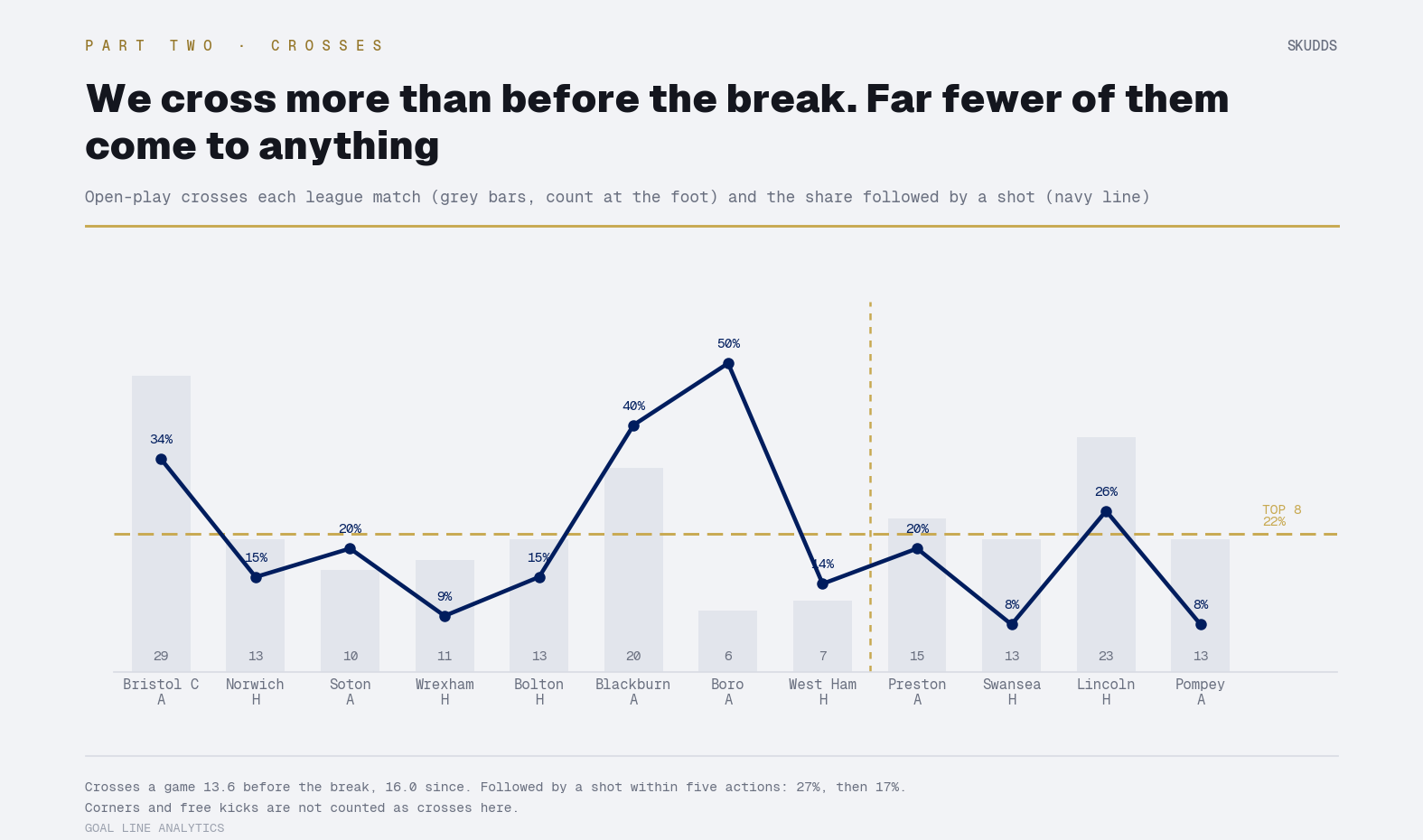
Here are the crosses themselves, from the last four games before the break and the four since.
Every open-play cross, from where it was hit to where it landed. Hover or tap one for who put it in and what came of it. We attack up the page.
What was always missing
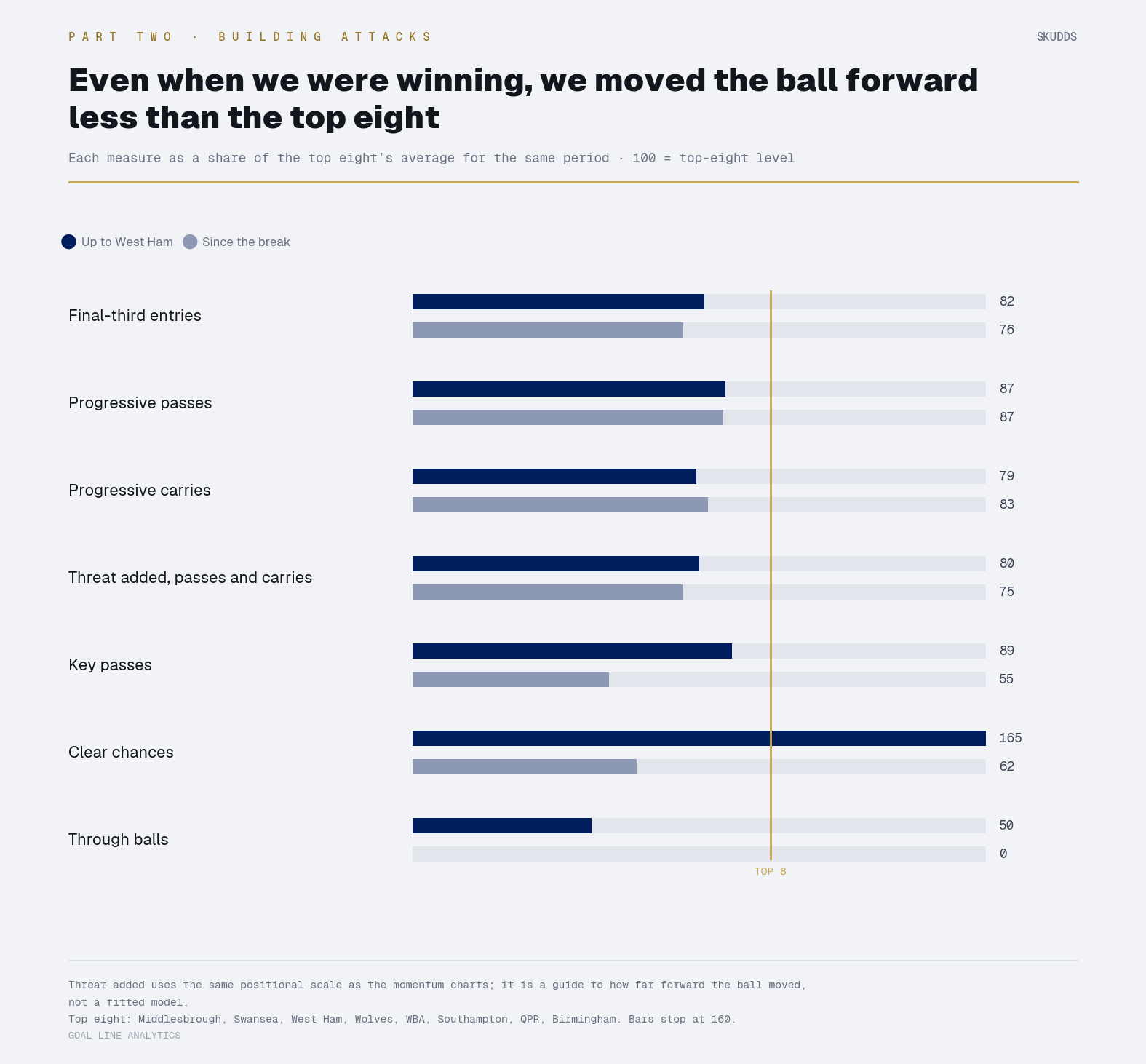
This is the uncomfortable part. Measured against the top eight, we were short at moving the ball forward even when we were flying: 82% of their final-third entries, 87% of their progressive passes, 79% of their progressive carries. We hardly play a through ball (none at all since the break, against one or two a game for the top eight). The counter-attacks and the crosses that found someone covered all of that. With both gone, it shows.
The clearest single number is key passes, the pass before a shot. We made 9.3 a game before the break. Since, it is 6.3, 23rd in the division, and the chances they set up are worth less. Clear chances have gone from 1.75 a game, the best in the league, to 0.75.
There is one number that looks good and is not. Since the break we have had 61% of the final-third touches in our games, 3rd in the division. That is mostly part one again: opponents barely get into ours. It is territory without threat.
Getting the ball forward is not where it breaks down. In the last four games before the break we completed 90 passes into the final third, and 21% of them were followed by a shot. In the four since we have completed more, 107, and only 15% led to one. We get there. Less happens when we do.
Every completed open-play pass into the final third, and whether we got a shot away before losing it. Hover or tap one for who played it and to whom. We attack up the page.
Four numbers that would tell us the attack is back
| Marker | Before the break | Since | Top 8, season |
|---|---|---|---|
| Counter-attack shots, a game | 1.75 | 0.25 | 1.09 |
| Crosses followed by a shot | 27% | 17% | 22% |
| Key passes, a game | 9.3 | 6.3 | 10.7 |
| Clear chances, a game | 1.75 | 0.75 | 1.10 |
Arconte coming back would move the first and probably the second. The third and fourth need more than one player. If the counter returns, the old problem goes back under the carpet. If it does not, we need a way to build that we have not shown yet this season.
Counter-attack shots are those the event data marks as coming from a fast break. A cross is open play only; it counts as leading to a shot if we shot within five actions. A progressive pass or carry moves the ball at least a quarter of the way to goal. Carries are measured from where a pass was received to where the next action began.