Hard to get at, easy to score against.What has gone wrong since the break.
We have looked poor for a month, and it is not the obvious things. Opponents barely get near us. When they do, they score from it. And at the other end, the ball we play forward keeps coming back.
From 1.38 points a game to one
Up to West Ham we took 1.38 points a game. Since the break it is exactly one: a win at Preston, defeats to Swansea and Portsmouth, and a draw with Lincoln we had to come from two down to get. We were 8th after winning at Preston. We are 13th now, five points off the play-offs.
Four games can look like a blip. In the Championship it is also exactly how a slide starts, and what is underneath this one is a pattern, not bad luck. Alex Neil said as much after Fratton Park: we need to “eliminate errors and do basics better.” This is what the basics look like in numbers.
From the second-best attack in the division to an ordinary one
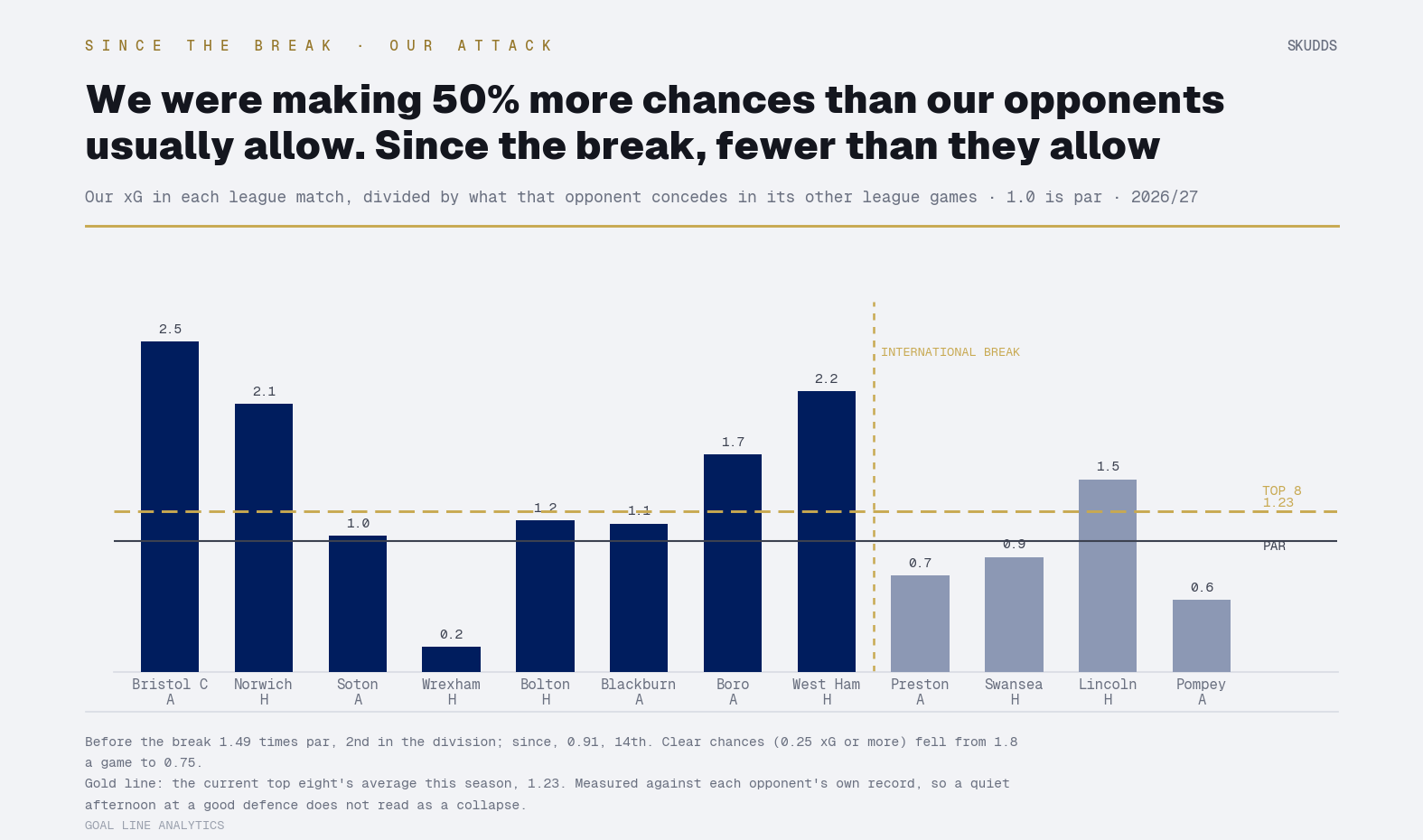
Raw expected goals flatter or punish a side depending on who it played, so we have measured every match against the opponent: our xG divided by what that side concedes in its other league games. Up to West Ham we were making 1.49 times what our opponents usually allow, second best in the Championship. Since the break it is 0.91, 14th. Clear chances (a shot worth a quarter of a goal or more) have gone from 1.75 a game to 0.75. The current top eight average 1.23 across the season: we were well above that, and now we are well below it.
The fixtures do not explain it. The four sides since the break were, on average, no better than the eight before it.
Up front, the long ball has stopped sticking
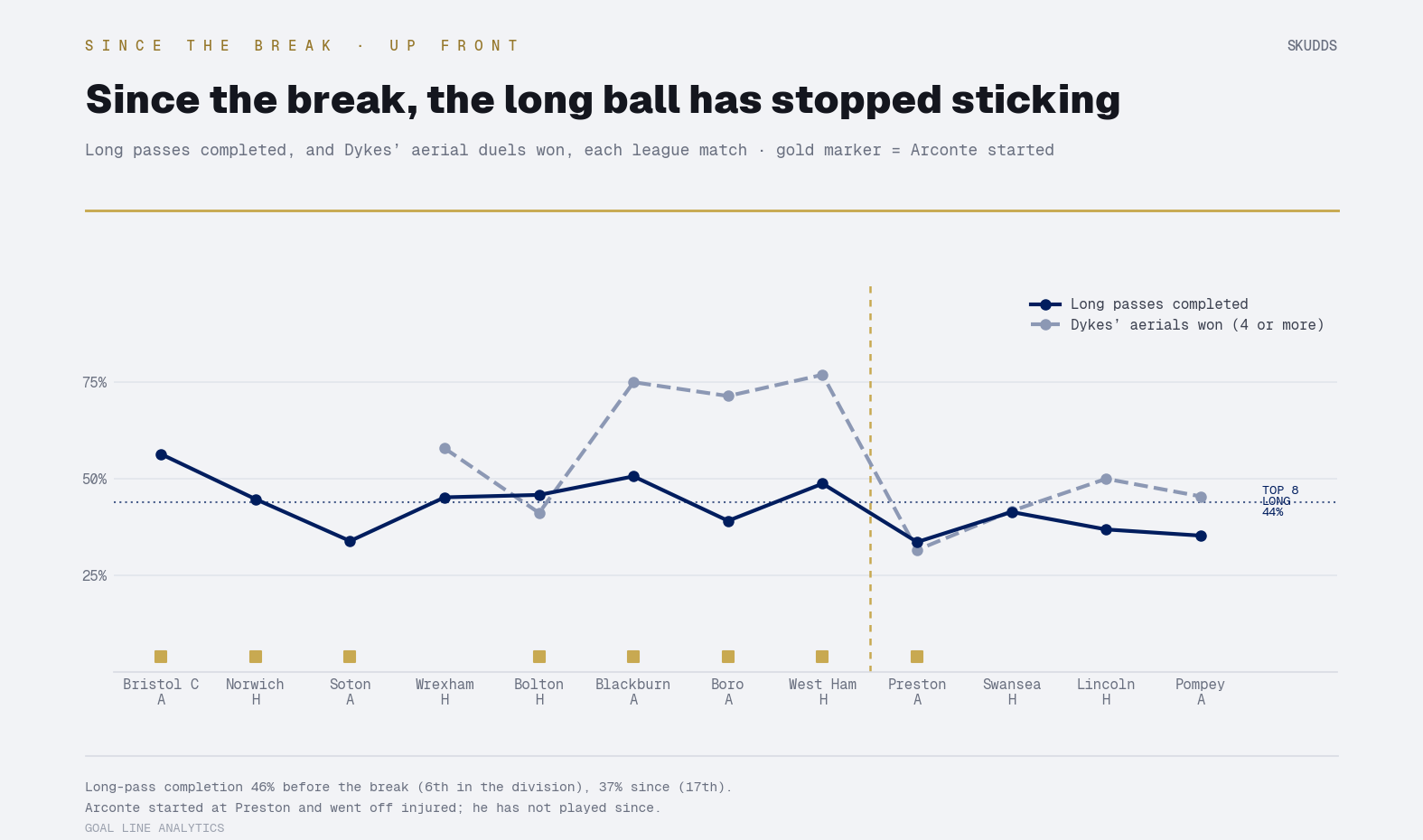
The giveaways that drive you mad are real, but they are not where you might think. Our short passing in our own half is as good as it was (86% before, 88% since). What has gone is anything played forward early. We completed 46% of our long passes before the break, 6th in the division. Since, it is 37%, 17th, and below the top eight's 44%.
Lyndon Dykes is our target man: he receives more of our long balls than anyone, more than twice as many as Tairyk Arconte. What Arconte gave him was a partner. He started eight of our first nine league games, five of them alongside Dykes, then rolled his ankle at Preston and has not played since. With Arconte on the pitch a little more of the long ball stuck (40% of long passes forward completed, against 37% without him). The bigger change is Dykes himself. On his own up front he has gone from winning 62% of his aerial duels to 40%. The ball goes long, it does not stick, and it comes straight back.
And we give it away far more than the sides we want to be with. The top eight lose the ball 19.4 times per hundred touches. We were at 25.1 before the break, when we were winning, and we are at 28.6 since. That gap is not new, but it is getting wider, and it is the clearest measure of the sloppy football you have been watching.
Nobody lets opponents in less. Almost nobody gives them more when they arrive
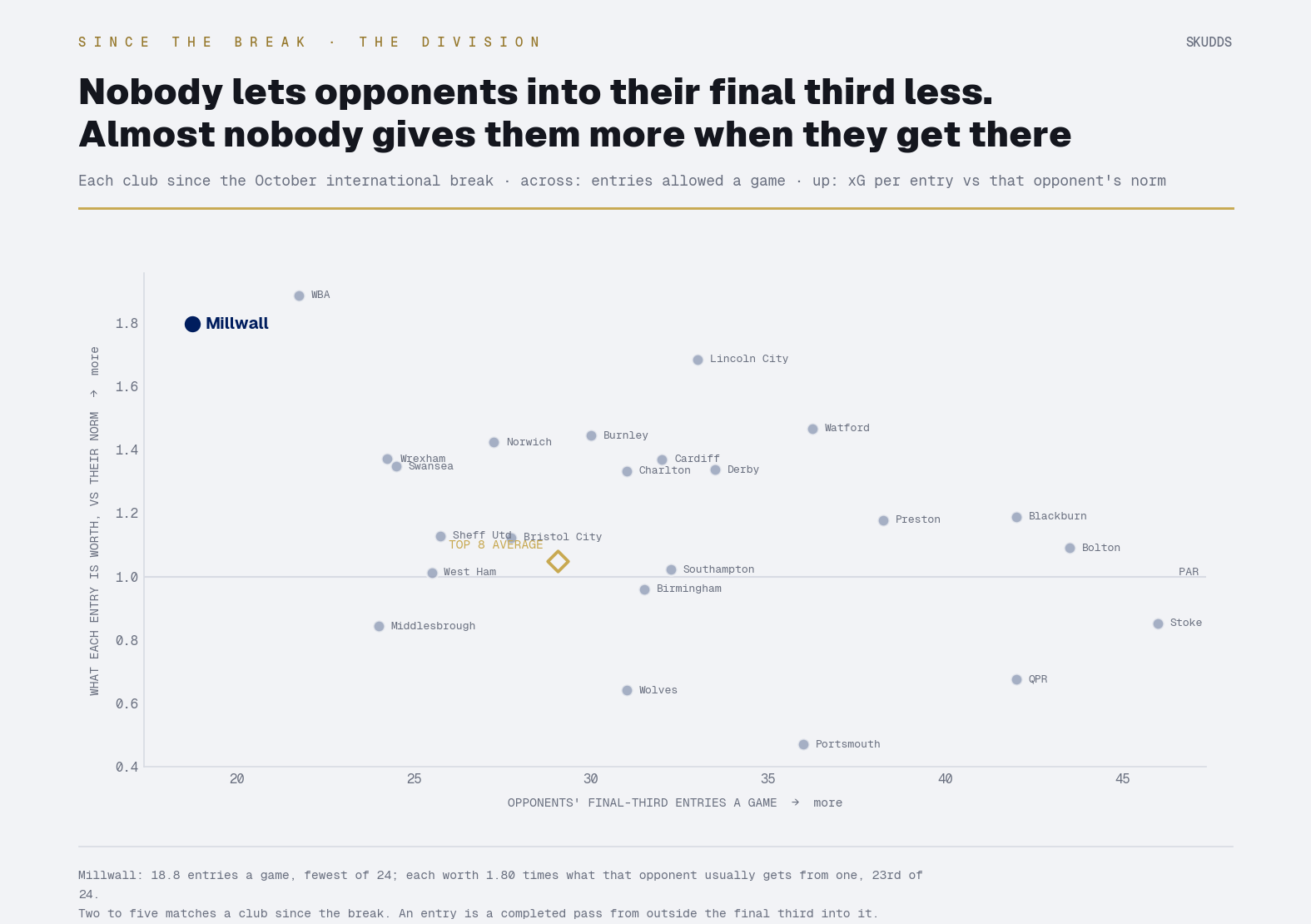
This is the strange one, and it is why we look so easy to break down without the overall numbers screaming. Since the break, opponents have reached our final third 18.8 times a game, fewer than against any other side in the Championship. Before it they managed 31.
But each of those entries has been worth 1.80 times what that opponent usually gets from one. Only West Brom are worse. We are hard to get at and easy to score against. The total we concede, 1.21 xG a game, is close to what the top eight concede (1.17). The difference is how. Their opponents reach the final third 29 times a game, and each entry is worth about what it usually is. Ours get there 19 times, and each one is worth almost twice as much. That is why the season totals do not look like a crisis, and why watching it does.
Four of the five goals came from a ball into our box
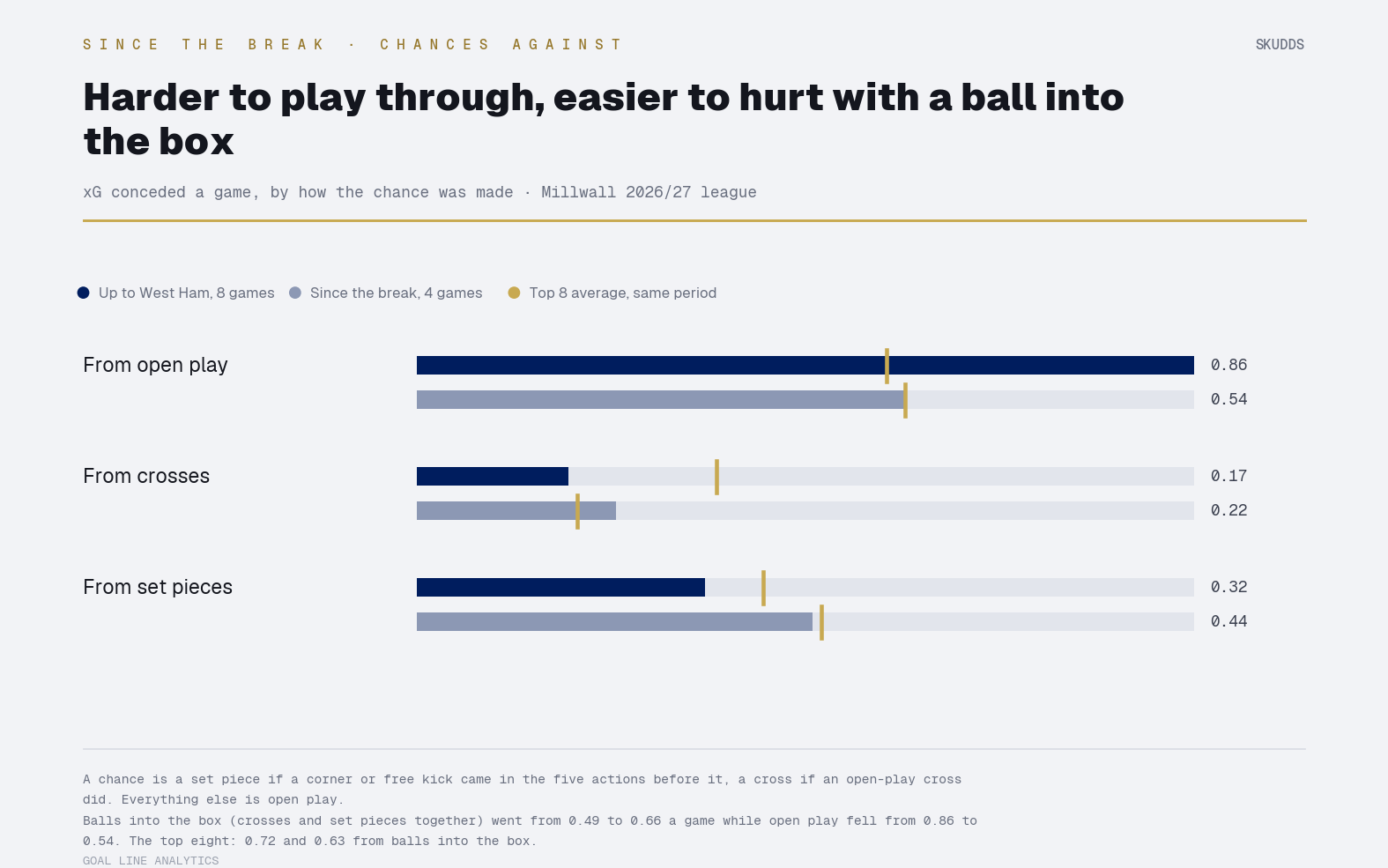
Split the chances we concede by how they were made and the picture is clear. From open play, through our midfield, we concede less than before: 0.54 xG a game, down from 0.86, and the same as the top eight. Metcalfe and Mazou-Sacko are doing their job in front of the back four. From crosses and set pieces it has gone the other way, 0.49 to 0.66. Before the break that was far better than the top eight (0.72). Now it is level with them (0.63). We have lost an edge we had.
The five goals since the break:
| Match | Goal | How |
|---|---|---|
| Swansea (h) | Ronald 89' | Cross from our right to the back post; nobody touched it |
| Lincoln (h) | Coubis, 25 seconds | Low strike in off the far post, after a cross |
| Lincoln (h) | Street 32' | From a corner |
| Portsmouth (a) | Dykes own goal 15' | From a set piece |
| Portsmouth (a) | Waddingham 81' | Open play: Cooper's clearance struck him and went in |
Neil put it in one line after Portsmouth: “We don't pick up the second ball. We don't match a runner into the box.” That is the data too.
They used to cross on us from the left. Now it is the right, and it costs more
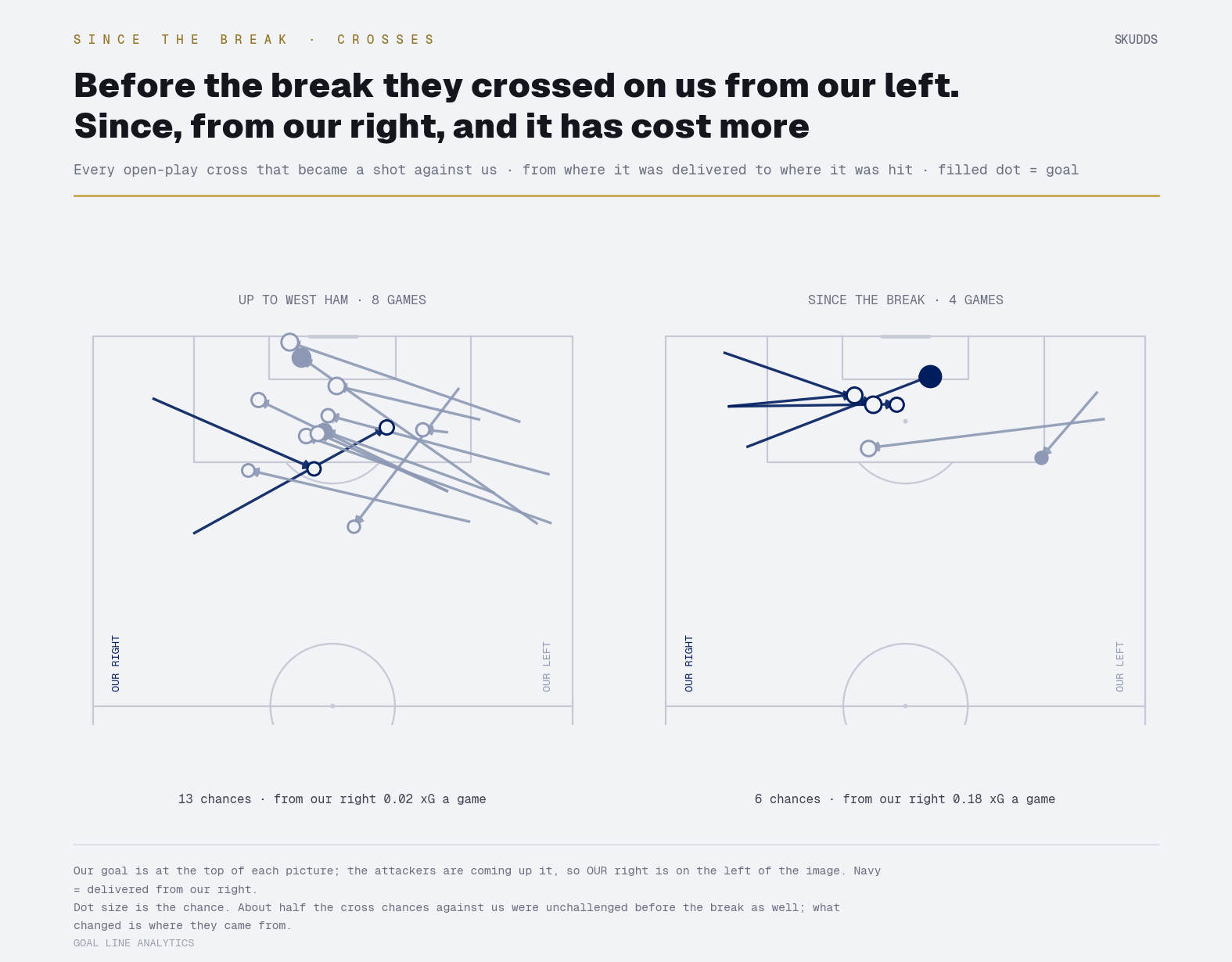
Before the break, eleven of the thirteen cross chances against us came down our left, but they were mostly hopeful: 0.15 xG a game between them. Since the break the danger has switched sides. Crosses from our right have produced 0.18 xG a game, up from 0.02, including Ronald's winner.
It is not one player. Last season the right side was settled: Tristan Crama behind Femi Azeez, two of the best players in the division. Azeez has gone. Crama hurt his ankle in the play-off semi-final, needed a second operation in August, and made his first start of the season against Lincoln. In four games since the break we have had three different right-backs and three different players on the right in front of them.
| Match | Right-back | In front of him | In goal |
|---|---|---|---|
| Bolton (h) | Osei-Tutu | Esse | Crocombe |
| Blackburn (a) | Osei-Tutu | Esse | Crocombe |
| Middlesbrough (a) | Osei-Tutu | Sykes | Crocombe |
| West Ham (h) | Osei-Tutu | Sykes | Marschall |
| International break | |||
| Preston (a) | Leonard | Lisbie | Marschall |
| Swansea (h) | Osei-Tutu | Sykes | Marschall |
| Lincoln (h) | Crama | Sykes | Marschall, then Crocombe |
| Portsmouth (a) | Crama | Neghli | Crocombe |
Crama himself is two starts into a comeback from two operations, and it shows on one side of his game only. Going forward he is already at last season's level or above: more progressive passes (10.7 a game against 7.7) and as many passes exchanged with the winger in front of him as he had with Azeez. Defending, he allowed 4.4 crosses a game last season and almost nothing came of them. At Fratton Park six crosses came in from his side in 76 minutes. That reads like sharpness, and two games is too few to say more.
Our left has got quieter. Cooper has not been himself all season
Zak Sturge's side has been the calmer one since the break. The crosses he allows are down from 8.2 a game to 5.1, and the chances from them from 0.19 xG to 0.07. Before the break his flank was where Middlesbrough and West Ham got in. Two things have dipped: he has not won a tackle in four games, which is either a quiet flank or a full-back standing off, and his forward passing is down from 6.4 progressive passes a game to 5.1.
Jake Cooper is not losing in the air: he has won 76% of his aerial duels since the break. But he has been dribbled past more this season than last (0.54 times per 90 minutes against 0.34), and his passing has dropped since the break, from 81% to 73%. That fits what you see. He is the one in the middle of a box where the ball is arriving more often from wide.
One thing is not new. About half the cross chances against us were met by nobody before the break as well. Leaving a runner free in the box has been a weakness all season. It is costing more now because more balls are coming in, from the side we keep changing, in front of three different goalkeepers, who have changed places four times in twelve games.
Derby and Birmingham will tell us which way this is going
Derby come to The Den on Saturday 23rd in the table. Birmingham away on Tuesday are 8th. If this is turning, it should show in five places, measured against the sides we want to be with:
| Marker | Before the break | Since | Top 8, season |
|---|---|---|---|
| Our chances against what the opponent usually allows | 1.49 | 0.91 | 1.23 |
| What each final-third entry is worth to the opponent, against their norm | 1.00 | 1.80 | 1.03 |
| Turnovers per hundred touches | 25.1 | 28.6 | 19.4 |
| Long passes completed | 46% | 37% | 44% |
| xG conceded from crosses and set pieces, a game | 0.49 | 0.66 | 0.69 |
The injury list will not do us many favours yet. Marschall is out with ankle ligaments, Arconte's return is day to day, and Coburn and De Norre have been out since Wrexham with no date given. Esse is back, and Jensen is close. If the right side gets a run with the same two players and the long ball starts sticking again, most of this should come back. If it does not, this is how 8th becomes 18th.
League matches only. “Before” is the eight games up to West Ham on 19 September; “since” is the four after the October break. Opponent norms are each club's averages in its other league games this season. An entry is a completed pass from outside the final third into it. A chance counts as a set piece if a corner or free kick came in the five actions before it, and as a cross if an open-play cross did. The top eight are the current top eight in the table: Middlesbrough, Swansea, West Ham, Wolves, West Brom, Southampton, QPR and Birmingham. Four games is a small sample, and the figures say what changed more firmly than why.
That is our box. The other half of the story is theirs: part two, the counter-attack we lost.